Radical Bay - An Article

Radical Bay - An Article


Jeff Schionning writes about this new design and the benefits he found using the twin un-stayed rig.


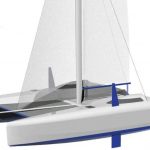
The Radical Bay 8000 design was introduced as 'a bit radical' and turned out to be a very sensible, simple, well behaved little rocket.

Introduced a couple of years ago she generated a huge amount of interest but understandably few sailors are prepared to take the 'risk' of building an untested rather different design. To show faith in our design and to make this concept a reality, 'we put our money where our mouth is' and built her ourselves.

The RB8000 was designed to be fast and simple yet she offers unexpected accommodation for her size, this being enhanced by her asymmetric inside flares. She is pegged to be a performance sailor, expected to finish in the top 5 when raced is good company, with very few 8 metre Multis much faster.

Layout

In the starboard hull you'll find a good cosy double aft, a galley amidships with a two burner stove, sink and running water, lockers and shelves. A big single bunk is forward. The port hull offers a head and shower aft with a basin and running water, 2-seater dinette with fold up table amidships (doubles as nav station), a big single bunk is forward.

On Deck

Outside between the hulls is a big open trampoline area, with a hard centre section (Could be a hard deck throughout if preferred for cruising). Two cockpit seats, one on each aft deck are comfortable to helm from. You'll notice only one winch - located on the forward beam.

Twin Rig

The twin rigs change the whole dynamics and are what makes her truly different. You will be used to a normal sailing cat. Having the masts set in each hull and no rigging opens the area up enormously. Having only 2 ropes feels a bit weird, seems like something is missing. This is true, a whole lot of clutter and about 10 grand still in your wallet.

Sailing Performance

The reality of sailing her was very interesting. Launched in a rush to reach the Sanctuary Cove boat show saw her launched late on a Sunday. With weather a bit ordinary, showers and a fresh cold South-Easter, we ran her out the marina with the 9.8hp two stroke outboard. She ripped along at 12 knots plus at full throttle. We double reefed, she has 3 reefs, but only 1 reef per sail. Reef 1 is one sail reefed, reef 2 is the other sail reefed and reef 3 is one sail down.

We had the 'hoon' team sailing her, some of our design and building team; Craig, Nathan, Eddy and Maurice. She took off like a rocket, smoking along at 12 - 15's plus, looking fantastic, reached all over the bay and then beat back home. Going upwind fast and close and perfectly balanced - the crew, looked a bit stunned with nothing to do.

We spent Monday adding last minute bits and left Tuesday midday ahead of a strong wind warning - heading up the coast - Port Stephens to the Gold Coast a bit over 300 miles - to the Sanctuary Cove Boat Show.

The delivery dished out all sorts of weather to give her a real test. Crew were Nathan Van Kerchoff, a very experienced small cat sailer, Eddy Haigh the builder and myself (designer and 'moderator'). Conditions strengthened as night fell, the boat felt good so we ran on, double reefed and flying, reaching at 12-15 knots in a choppy sea with a huge southerly swell. A bit nerve racking on an untested boat but we pushed on reaching Coff's Harbour the next day. Left the following day to keep ahead of what was now a gale warning for home waters and a strong wind warning for our area. We do this a bit too well and run out of wind. Motor sailing into the seaway Friday evening and stopping at the friendly Southport Yacht Club for a beer and food.

Design Evaluation

I found it interesting to re-evaluate this design with the experience I gained over the last four days in some quite testing conditions.

Firstly - tough luck to the thousands of knockers who said it would never work, tough luck guys it works a treat.

The most obvious concern was the one sail blanketing the other, this was always going to happen but to what extent? Very interesting - one perceived negative turned into a couple of strong positives. At 90 degrees apparent the leeward sail goes neutral, no flapping or fuss, the options are to change course a little to windward and ,bang, she pulls up and off again. Where we wanted to hold our course up the coast with a dying breeze we simply opened the windward sail releasing the sheet until the windward sail fed the leeward sail, looked odd but worked very well.

The upside of this 'supposed' problem was the ability to easily reef one sail in a gust or to slow down for a rough patch. While flying along with two reefs we found it very useful, simply alter course slightly blanket the leeward sail. This effectively reefed her without any crew effort, once through the gust, simply point her up again and back up to full power. Another benefit was to use the same tactic to de-power the one sail when you needed to reef, you could then reef easily, a relaxed shadowed sail making the job very easy.

Interesting Observations of this twin rig system

1. We could use either sheet to control both sails or simply cleat the mid section of the sheet and use the sails independently.

2. The booms are solid mounted to the mast and can be rotated 360 degrees with only the light 2:1 sheet restricting this, you need to return the way you went. Sail control is so simple, no concerns about supporting or controlling the boom. We had crew lying on the flat top of the boom, good place to put your beer as well. Sails simply drop onto this flat top controlled by the lazyjacks.

3. One winch on the beam is used for both masts. It controls the outhaul, reefs and halyard, simply clutched on the boom. A simple Cunningham type purchase is used to downhaul the luff, this is also used as the reef hook.

4. Running down wind is very easy, winging out the two mains is extremely effective and simple, the windward sail can be run by the lee, simply rotated fwd of 90 degrees.

5. Interestingly, sailing with full mains or at any of the reef positions did not alter the steering balance at all.

6. The huge safety gained by having the much lower centre of effort was very apparent. Sailing hard and fast she had no heel effect and felt as though we were powered by a big outboard motor down at beam level. Very different to the normal high centre of effort and low drag position that increases pitching and rotation moments.

7. Ease and control of reefing each sail was much easier than a normal cat, small sail areas and the option to alter course to bring each boom into the safe deck area plus the already mentioned ability to blanket one sail with the other helped a lot. No flapping sails gives a much more peaceful feel to it all.

My Conclusion: Fantastic, simple, practical, I can not see why these rigs will not be used on all our cats soon as well, yes, as well as the bridgedeck cruising cats. Sailors are slow moving and suspicious of change but any thinking, intelligent person will immediately see the advantages should they come for a sail on this design.

An area we have not as yet tested is the manoeuvring under sails in confined areas. It stands to reason that with the rigs separated as they are you should be able to use the sails in a similar way to twin motors. She tacks like a dinghy, except nothing to do. We found in very light airs or should you loose way and get into irons the two rigs give the option to sheet in either sail to more easily get you out of it, more time will I am sure throw more light on things.

Negatives: Questions centre on the cost of 2 carbon masts, fair enough, we built these simply ourselves using foam plugs, not hard, and not too expensive. My judgement is a big saving in overall cost considering there is no rigging, no headsails and furlers and no spinnakers and very little deck hardware.

One very big positive that I've not yet looked at carefully is the far better layout options we can look at in the bridgdeck cats by opening up access between the saloon and fwd cabins, this is usually blocked by a major structural bulkhead.

The possibilities are exciting!


Construction

The Radical Bay 8000 is build using DuFlex balsa cored panels. A pre-cut kit is available that includes all the bulkheads, hull panels, furniture. Almost everything is pre-cut. The only strip planked area is the small curved cabin top. The kit also includes the aluminium beams.

We will consider offering a plywood option for this design (depending on demand) but this would not be pre-cut, full size plots would be supplied for you to cut your own panels.

The boat is demountable so can easily be transported worldwide by container. Builders are available to quote to any stage.

More photos and information at www.schionningdesigns.com.au Or email info@schionningdesigns.com.au

If you're a little adventurous we would love to talk to you about these next generation Multihulls.

Link Page


Schionning Designs 2010
Created By WebRaven ©